Things you don’t want to hear your psychiatrist say when you tell her you have the flu:
“Wow. You get sick more than anyone I know.”

Things you don’t want to hear your psychiatrist say when you tell her you have the flu:
“Wow. You get sick more than anyone I know.”
Never say to your therapist, “It’s complete batshit insanity!” in reference to a fairly common work problem. Because their insanity scale is slightly skewed, and starting your story with this statement is bound to produce an unimpressed reaction when you hit the big “And THEN I was expected to finish ALL THAT PAPER WORK in only TWO days!” climax.
Oh also it’s highly offensive and insulting to their entire profession. And to you.
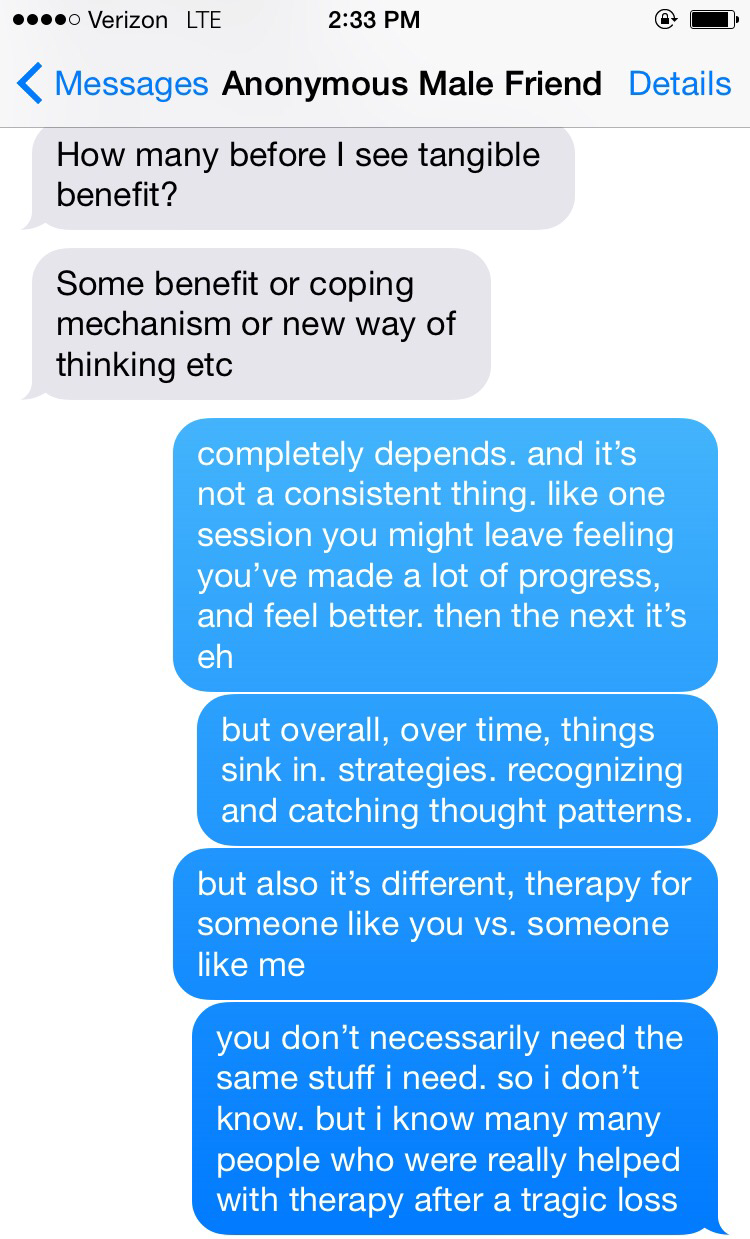
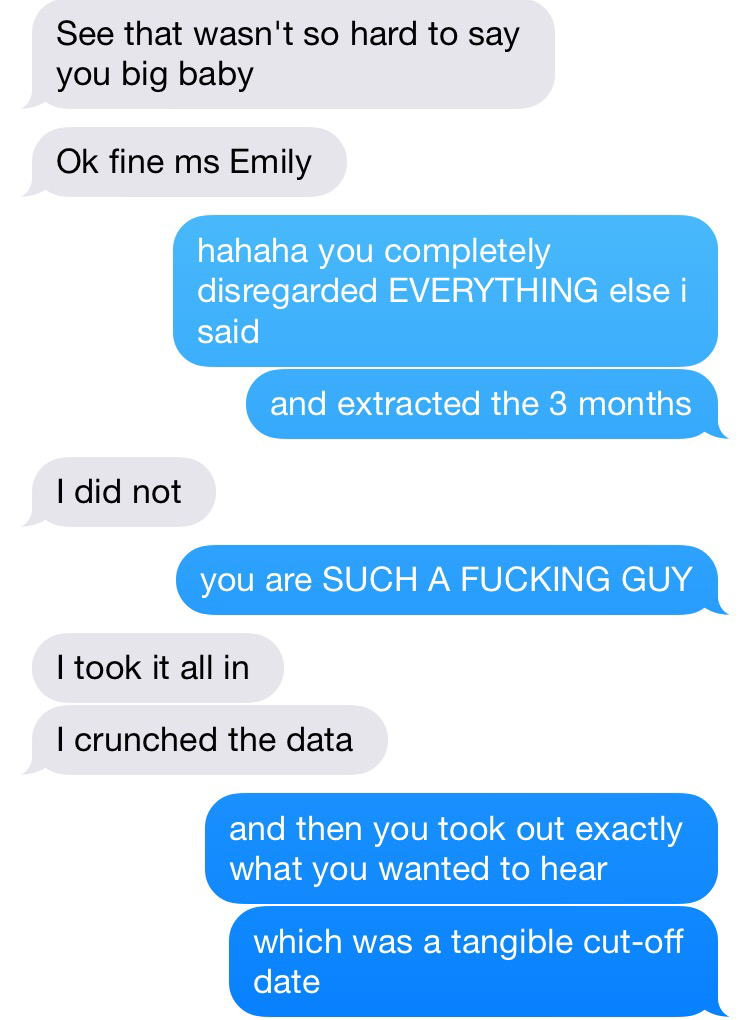
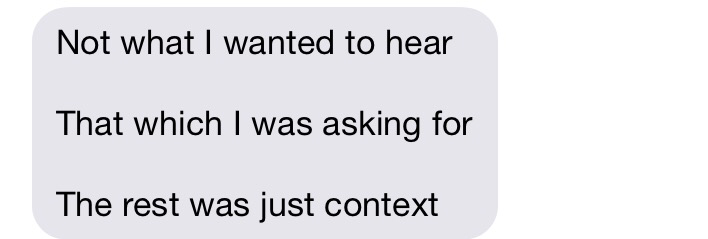
I have a male friend who recently went through some tough times and, partially due to my influence, has now started therapy. I’m so proud of him for giving therapy a chance, but still– as this conversation* highlights, could he BE more of a dude?
(*posted with his full permission and approval):


Rewind to seven years ago– something I do often, just to keep myself in check. I’m sitting at the kitchen counter in my childhood home, 26 years old, in the midst of an acute, debilitating depressive episode, watching my parents have a conversation. It’s about nothing– a simple, benign exchange about their day. But I am entranced.
“Yo,” my brother Jeremy says, tapping my arm. He sees I am lost in what has been a months-long, perpetual state of bewilderment, anxiety, and terror. “You alright?”
“How do they know?” I asked.
“How do they know what?”
“Mom and Dad– having a conversation. How do they know whose turn it is to speak? How do they know who is supposed to talk next, and when, and for how long? How does anyone know this stuff?”
He stares at me long and hard. “Dude,” he whispers, in the most loving, gentle way possible. “You’ve gone batshit.”
It isn’t the most eloquent way to describe what’s happening, but it’s probably the most apt.
When I was depressed, here is what people didn’t get. Yes, I was sad– bone-crushingly, soul-achingly sad– but I wasn’t just sad. The experience was so much more than sadness. I was constantly subsumed by unrelenting confusion, anxiety, and panic. I was in an altered state of being. I was trapped in my body while a stranger took over my thoughts and actions, and did an incredible job of convincing me that I knew nothing about the world, and never had.
The simplest things made no sense. The act of breathing became a perplexing phenomenon that begged the question, “How did I ever do this automatically– how did I know when the time was right to take the air in, then let it out again?” Words on a page became curious squiggles and dots that contained no meaning. Conversations became puzzles I couldn’t quite solve. Sitcoms were aired in a foreign language I had never learned. One of the scariest days of my depression was when I discovered that I could no longer follow an episode of “Friends.” It was just too confusing.
Society, and how to actively participate in it, became a concept that I was no longer able to wrap my head around. I wondered, constantly, how I had ever done it so easily. How I had interacted, how I had known what to feel and when to feel it. Forget joy being sucked out of life– everything was sucked out of life. The ability to care, the ability to connect. The ability to believe that it would ever change. Every thought, every action, every second was labored. Time was meaningless, except in the sense that it dragged on endlessly, torturing me at every turn with its emptiness.
I want to make it clear that I was never what the professionals would deem “suicidal,” in the sense that I never made a plan and never truly considered ending my life as a viable option. But my god did I wish I was dead. I can say, bluntly and without shame, that I wholeheartedly understand why people kill themselves. I have seen the world through a depressed lens, and I can tell you that when I was in that place, the only thing standing between wishing I was dead and making myself dead was the unending, dogged, relentless system of support and understanding that surrounded me.
Support and understanding– you absolutely need both. The support part I never lacked. Not for a second. I have an incredible family who did everything they possibly could to get me well. They listened to my choking sobs, self-defeating rumination and irrational fears, even though I knew it tore them apart to do so. My friends were in touch every day, reminding me of my place in the world, and how much they were relying on me to stay in it. I had the resources. I was fortunate in that my family could afford to get me the best help possible, no matter what the cost, no matter how much time it took. The support was immeasurable and I will never take for granted how lucky I was to have had it, and how blessed I am to continue to have it today.
But support alone, tragically, is sometimes not enough. Because in my case, even the most impassioned support was, at times, no match for the demon I was facing. What I needed most– what I desperately craved– was understanding. True, genuine, I’ve-been-there-and-you’re-not-alone understanding. Everyone around me sympathized; very few could relate. But I will never forget, and will always appreciate, how unbelievably hard my friends and family tried. They wanted so desperately to understand what I was feeling, to make it go away, to absorb some of it into themselves so that I could feel it less. But through no fault of their own, they couldn’t. And the more I felt as though no one understood, the more isolated and hopeless I became.
By the grace of god, in the midst of my depression, I discovered mental health organization Active Minds. And that’s when things began to change. Active Minds provided for me that community of understanding that my friends and family, try as they might, simply couldn’t. Had I not connected with Active Minds, and through it, gained access to a world that embraced and understood mental illness, I’m not sure how my story would have ended.
Active Minds gave me a place to go when I felt as though I belonged nowhere. I was vulnerable, terrified, and scared as hell. But I reached out to them and they embraced me. They gave me a purpose. In a time when I was struggling to find meaning in anything, they gave me a reason to believe in myself and believe that I could, and would, get better. That I had value in this world. Because many of them had been there themselves, they absolutely understood what I was going through, and they knew I’d come out of it. And when you’re depressed, believe me– that kind of understanding is everything.
With the support of Active Minds, my incredible family and friends, and good medical care, I came out of that debilitating depressive episode, fragile at first but then stronger than before. Am I cured? No. Depression, for most, is a lifelong battle, and to claim otherwise would be to delegitimize it. But I learned how to fight. I learned (and continue to learn), through therapy, openness, and connection with others who’ve been there, how to take care of myself— how to recognize my own thoughts versus the depression, how to utilize my resources, how to be true to myself and accept who I am, flaws, illness and all.
Four years after that debilitating depressive episode, I was living and thriving in New York City when Ari Johnson, a dear friend of mine, took his own life. On the day I learned of his death, I had had no idea that he was struggling. I still don’t know the extent of it. It haunts me, knowing I could have reached out and provided him with that understanding, had I only known. It pains me that Active Minds, and its message of hope, compassion, and stigma-fighting, did not have the chance to touch his life, to possibly save him in the way it saved me. So now, I can only hope his death will save the lives of others– that our telling of these stories, of my story, and of Active Minds’ story, will inspire those who suffer to reach out. Otherwise, what was it all for?
Active Minds is, every day, changing the conversation about mental health, and in doing so, changing lives. It is creating a world where we can feel just as comfortable seeking help for mental illness as we would seeking help for a broken limb. A world where there is no shame, no stigma, no reason to feel so desperately alone. No reason to lose hope.
We’re not there yet. But we can get there.
And I promise– things can be funny again.
In therapy, I always know that my therapist will be super impressed when I am able to put a positive analytical spin on a negative situation. After all, this kind of optimisim has taken me years to accomplish:
“So, I hurt my ankle over the summer while training for a marathon. It was a silly accident– I tripped over a tree root. It wasn’t an acute, horrible pain, but over the next few days, my ankle just felt generally weak and sore. So I decided to rest it for a few days. When I tried running again the next week, I still couldn’t. So I had to give up the marathon, which was hugely dissapointing, and take a longer hiatus from running. Just recently though, months later, I started to get back into it, running almost every day. And now my ankle is acting up again. And you know what? I think this might be God’s way of saying ‘SLOW DOWN, Em. Take a moment. Life isn’t a race. Breathe. Look around, appreciate what is happening in the now, and stop trying to run from your anxieties.’ So, see, the hurt ankle is actually a blessing– a constant reminder to stay focused in the present.”
I sat back, crossed my arms, extremely satisfied with myself for being so optimistically thoughtful.
Therapist: “I think God is telling you to get an x-ray. You might have a stress fracture.”
It’s a therapy-lamp-at-work kind of day over here.
“Oh! Can I get tan from that?”– my boss, excitedly standing in front of it.
No. No you cannot.

My therapist once said to me, as I picked apart every word and action in the midst of what I was convinced was a relationship crisis— “You know, Emily, not everything always needs to be analyzed. Sometimes things just are what they are.” And I totally agree.
But, like, what do you think she meant by that?

Many of my friends have told me that their parents love reading my blog, and I can’t tell you how happy that makes me. It has recently come to my attention, however, that not all of them are thrilled with the amount of cursing in some of my posts. I’ve heard this from several people. Just this week my friend told me her mother read one of my posts and then declared, “Emily said the f-word. I really didn’t like that.”
I know, Rhonda. I totally hear you, and I 100% get why you didn’t like it.
Because for most of my life, I didn’t like it either. Once I became aware that cursing was no longer socially “appropriate” for someone of my gender, age, and background, my foul mouth became my least favorite thing about me. In fact, every single New Years, I would vow to curse less. This was a great way to start off my year– by disappointing myself. FUCK. Why is this so hard? (Side note: To be clear, I never curse at work. In front of the kids, that is. Give me some credit, people. Or don’t. I get why you wouldn’t.)
I grew up cursing as a form of self-expression. This was not a result of bad parenting– my parents are amazing role models, and none of my siblings curse as much as I do. But there were no strict rules about it in our house, and for whatever reason, I’m the one who decided to take advantage of this and adopt “fuck” as an emotive tool. I had (and still have, as any one of my scarred ex-boyfriends can attest to) a LOT of feelings– feelings that need to come out or they’ll eat me alive. Cursing helps me express those feelings. And not just the bad ones– “fuck” works great for excitement (I’m so fucking excited!), anticipation (I can’t fucking wait!), amazement (Are you fucking kidding me?!), joy (I’m so fucking…ok you get it…I have a tendency to over-explain. It’s the teacher in me)— basically any feeling that you’re REALLY feeling. I am someone who feels feelings HARD, and for me, cursing more accurately captures the strength of the feeling.
Also, it’s fun.
But as I emerged from childhood and became more aware of my surroundings and critical of myself, I began to feel self-conscious about it:
“Smart, educated girls shouldn’t curse.”
“Guys don’t like girls who curse.”
“You sound immature.”
“It makes you seem abrasive.”
Unfortunately, cursing had been my reliable and trusty form of self-expression for so long, it was hard to stop. But I kept trying. And failing. And when I failed, I beat myself up about it. So you see, it was an extremely healthy, productive, and air-tight cycle of self-loathing I created for myself. We’re talking George Costanza levels of self-defeat.
Years of therapy and a huge nervous breakdown later, I have come to see that my struggle with cursing is a just a small side-battle in the larger full-scale war of my young adult life— my war with “The Shoulds.” Since my teenage years, I’ve been trying desperately to do and achieve all the things someone of my background SHOULD do and achieve. I have spent so much time measuring my thoughts and actions against the long mental list of “Shoulds” that I (with the help of society) have created for myself. And when I wasn’t living up, I berated myself and felt terrible. It wasn’t until I learned to start letting go of “The Shoulds” that I began to feel more comfortable in my skin, more content with myself, and better able to accept who I am, (copious) flaws and all. (This, by the way, is and always will be a huge work in progress, lest you think I am an example of a truly evolved being. Oh, you weren’t even remotely thinking that? Ok, cool. Good.)
So, that’s me. Or part of me, at least. I curse.
And you know what? I feel pretty fucking great about it.

 Emily's Posts